The Popcorn Cycle
From Labubu to “Ban AI”, the 2-year cycle that runs politics and brands.
Everything is a trend
Everything has a cycle. Products, trends, brands, ages, politics, personas, technology. Nothing escapes it.
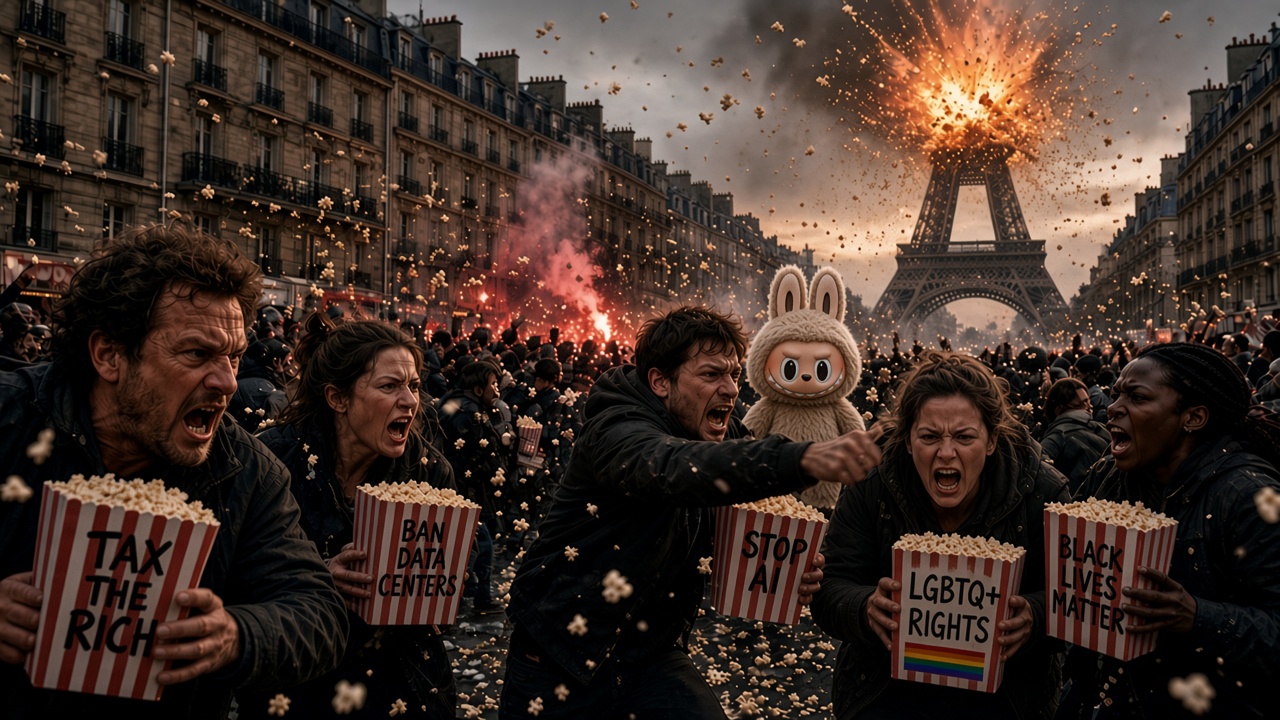
There’s one kind of cycle I like to call the Popcorn Cycle. It’s the moment a new trend or a new idea pops up and becomes the thing everyone talks about. People adopt it. They believe in it. Or, at the very least, they try to be part of it.
Popcorn is the perfect picture. A small, hard kernel sits there doing nothing. Then the heat hits at the right moment, and pop. It explodes, it’s everywhere, it’s easy to consume. And before you know it, the bowl is empty and everyone is looking for the next one.
Look at politics. Roughly every two years, a new concept arrives for people to believe in. A populist wave that pulls people in, each for their own reasons, and creates a powerful FOMO. Black Lives Matter. Then the debates around “woke” and DEI. Then COVID, which reshaped how we lived, talked and argued. Then Free Palestine. Then the rise of socialist ideas and “tax the rich”. And the next one is already warming up: stop AI, and the fear of job replacement.
I’m not here to judge any of these causes. Many are rooted in real pain, real history and real questions, and some will matter for decades. My point is about the shape of the wave: how fast it rises, how wide it spreads, and how quickly the spotlight moves on.
NFTs, DEI, AI: same cycle, different headlines
Now look at brands. Marketing teams, product teams and companies launch a new concept, a new trend and a new product every few years, following the exact same pattern.
Crypto and NFTs. Trading cards. Pokémon Go. Labubu. And so on.
NFTs are the textbook case. In January 2022, NFT trading volume hit around $17 billion. By September that same year, it had collapsed to about $466 million, a 97% drop, according to Dune Analytics data reported by Bloomberg. Pop. Eat. Empty bowl.
Labubu is the popcorn of this moment. Pop Mart, the company behind it, grew its revenue by 184.7% in 2025, to RMB 37.1 billion. The Monsters line, home of Labubu, made RMB 14.16 billion on its own, up 365.7% in a single year. And yet, when those results came out in March 2026, Pop Mart’s shares fell more than 20% in a day. Investors were asking the popcorn question: how long can one kernel keep popping?
Trends are what keep the economy moving. They keep the political spectrum moving. They keep the money machine running.
It was never about the product
I’m writing this from experience. I led the election campaign marketing for a former Lebanese Prime Minister, twice. And here’s what I learned.
It was never about the quality of the product. It was never about the new feature, or even the persona. It was always about how you present it.
That’s the catch.
Belonging on repeat
We in marketing have a mission bigger than branding, SEO, CRM or GTM. Those are the basics. They’re the old, fundamental building blocks of any campaign, product launch or testing phase. Necessary, yes. But they’re not the whole job.
As marketers, we should be the engine that builds these phenomena. We create the need and the feeling that make people believe they belong to something. Something they’re willing to fight for, engage with and adopt. Often without spending much time educating them about the political spectrum or the product itself.
Is that education really what moves people? That’s the uncomfortable question.
Many experts will argue with me. They’ll say people care about policies, product quality, the details. Maybe. But be honest. When you buy those expensive sunglasses, do you really check whether they’re good for your eyes? Or do you care more about owning what’s on trend?
I’d ask the same question about politics, with respect. When people join a movement, whether it’s Free Palestine or any other cause, how many arrive through the history and the details, and how many arrive first through the need to stand with others and belong to something bigger? I suspect that for most of us, belonging comes first and the details come later, if they come at all. That’s not a criticism. It’s human nature. And it’s exactly what the Popcorn Cycle runs on.
So, do we really care? Is caring even the point? Or is it more important to belong to the cycle?
That’s the popcorn concept. Simple as that.
Marketers don’t ride trends. They build them.
So what am I really saying?
Marketers have a much bigger role than most CEOs and HR departments think. It’s not only about go-to-market. It’s not about jumping on a wave someone else created. It’s about building the wave.
Can we build a trend? Technically, on paper, no. You can’t write a trend into a strategy deck and expect it to pop. A trend needs many elements at once. It’s like a pulse. You need to understand the user. Their need. The atmosphere of the moment. And then you need to deliver something at exactly the right time, so it turns into popcorn: quick to explode, quick to eat, quick to become huge.
That’s the craft. Not the logo. Not the funnel. The heat, the timing and the kernel.
The next pop is already warming up. The question is whether you’ll be watching it, or making it.
Sources
NFT trading volume down 97% from its January 2022 peak ($17B to $466M by September 2022, Dune Analytics data), Bloomberg. bloomberg.com ↗
Pop Mart 2025 revenue RMB 37.12B (+184.7%); The Monsters RMB 14.16B (+365.7%), Pop Mart 2025 annual results announcement. prod-out-res.popmart.com ↗
Pop Mart shares fell more than 20% after the 2025 results (March 25, 2026), Reuters. reuters.com ↗